
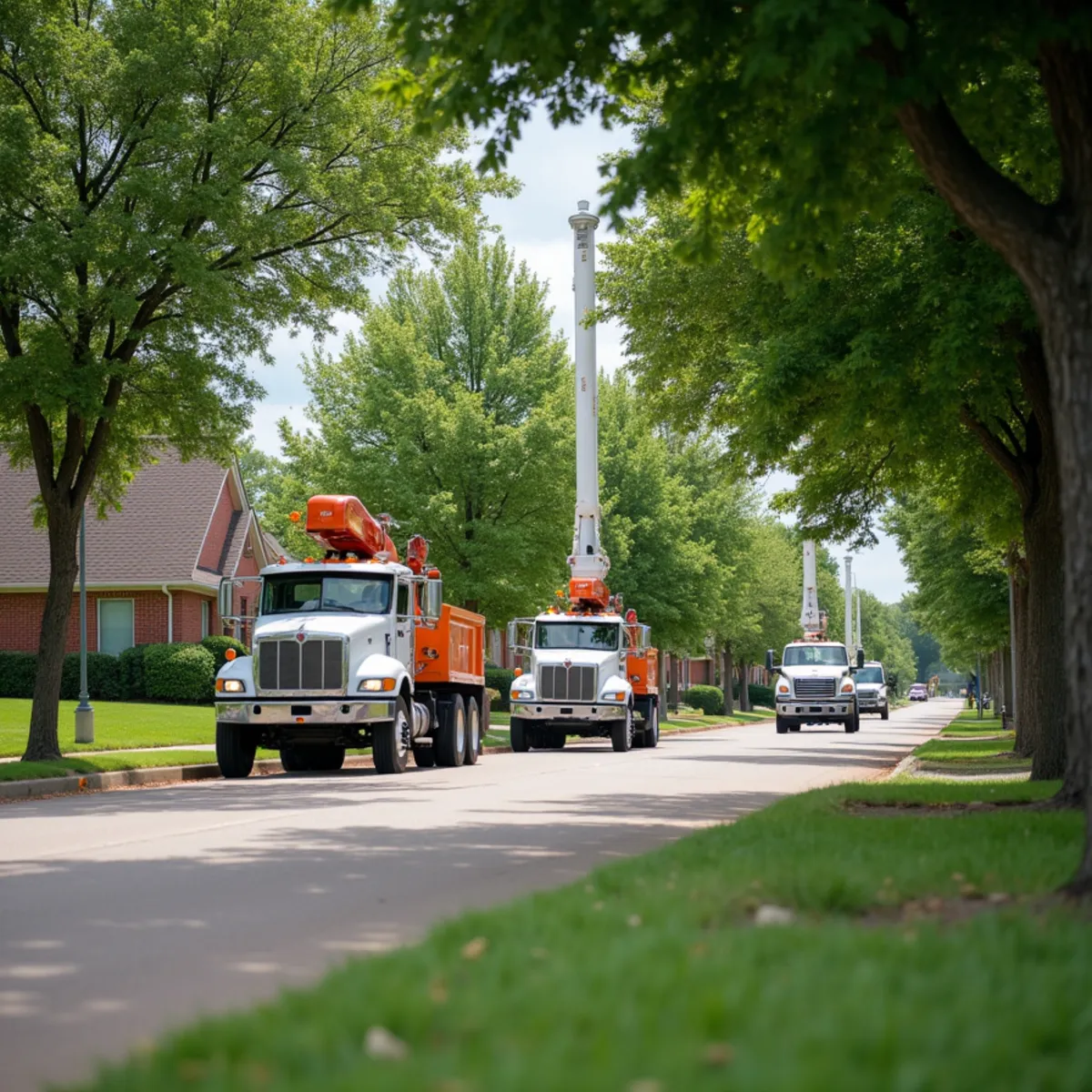
HOA boards in Frisco and across Denton and Collin counties are stuck between two pressures. Homeowners and buyers want tidy, uniform, attractive street trees, so the covenants push for a certain look. But the same trees, if they are maintained only for appearance, become storm-failure and liability risks that land back on the association. Balancing curb appeal and safety is the whole job.
The trouble is that a lot of HOA tree rules are written by people focused on aesthetics, not tree health, and some of the most common requirements actively make trees more dangerous. A board can enforce a standard that looks good this year and produces a wave of split trees the first big storm.
Here is how to write and enforce HOA tree guidelines that keep the neighborhood looking sharp and standing up to North Texas weather.
Where appearance-only rules go wrong
The most common mistake in HOA landscaping standards is encouraging or tolerating topping and over-thinning to keep trees small and uniform. Topping, cutting branches back to stubs, produces a flush of weak, densely attached sprouts that are far more likely to fail in wind than the original limbs, and it leaves wounds that invite decay.
Over-thinning and lion-tailing, stripping out the interior growth so all the weight is at the branch tips, look neat but leave a tree that is both weaker and more prone to sunburn and limb failure. Rules that reward these practices trade a tidy look now for a dangerous, declining canopy later.
What good HOA tree standards include
Guidelines that protect both curb appeal and safety are not complicated. They set expectations for consistent, professional care rather than dictating harmful cuts.
- Require pruning to recognized standards, referencing proper practices rather than topping
- Ban topping and lion-tailing outright in the covenants
- Set clearance standards over sidewalks, streets, and homes for safety and access
- Require use of qualified, insured tree services for common-area and street trees
- Include a schedule for inspection and routine maintenance of common-area trees
- Address oak wilt precautions, including pruning timing and painting cuts
Species selection sets you up to win or lose
A lot of HOA tree trouble is planted, literally, at the start. Neighborhoods that were built out with fast, cheap, weak-wooded trees like Bradford pears are the ones dealing with waves of splitting trees fifteen years later. The species an HOA approves for new plantings and replacements shapes its storm risk for decades.
Boards can head off future problems by steering replacement plantings toward sturdy, well-adapted species for North Texas, such as native oaks, cedar elms, and other tough hardwoods, and away from known problem trees. It costs no more to plant a good tree than a bad one, and it saves the association years of removals and claims.
Diversity is the other half of smart species policy. A neighborhood that planted a single species up and down every street for uniformity is one pest or disease outbreak away from losing its entire canopy at once, and one oak wilt center can move through a block of identical live oaks with nothing to stop it. Mixing in several well-adapted species keeps the streetscape cohesive while spreading the risk, so a problem that hits one type of tree does not strip the whole community bare. A good landscape standard encourages a short approved list of sturdy species rather than mandating one.
Uniformity without butchery
Boards often worry that healthy pruning means giving up the uniform look. It does not. Proper structural pruning and consistent clearance standards, applied by the same qualified crew across the neighborhood, produce a clean, cohesive appearance without the harmful cuts.
The trick is consistency of care, not severity of cutting. A neighborhood pruned to a standard by one competent crew looks more uniform than one where every homeowner hires a different low-bid operator to top their own tree. Our tree trimming and pruning teams work with HOAs to keep street and common-area trees uniform and healthy at the same time.
A board can put this into practice with a simple approved-contractor requirement for work on protected and common-area trees. When every tree on the property is pruned to the same standard by qualified, insured crews, the association gets the tidy, cohesive look homeowners want, the liability protection of documented professional work, and healthier trees that will not become next decade's removal budget. It also spares individual homeowners the confusion of guessing what the covenants allow, since the standard and the crew are already set.
A partner for the whole community
The associations that handle trees best treat them as long-term infrastructure: written standards that reward good care, sensible species choices, a maintenance schedule, and one insured, qualified partner for the common areas and a resource for homeowners. That approach keeps the neighborhood attractive and dramatically cuts storm failures and the liability that comes with them.
We work with HOA boards and property managers across Frisco and the Denton and Collin county communities as their commercial tree service partner, handling common-area maintenance, storm response, and guidance on standards. Call (855) 615-0568 for a free HOA tree management plan.
Where HOA rules and the tree's health actually collide
Most Denton and Collin County HOA letters ask for a flat, uniform canopy line across a street. That demand often pushes crews toward topping or heavy heading cuts, which are the two fastest ways to ruin a tree. A healthy live oak or red oak answers a topping cut with a cluster of weak water sprouts that snap in the first strong storm. We read the covenant, then propose crown reduction at the branch collar instead, which satisfies the sightline without inviting decay or regrowth the board will complain about next year.
The other friction point is the oak wilt window. Denton and Collin sit inside active oak wilt territory, and many HOA deadlines land in spring, exactly when you should not wound an oak. We document the February-through-June no-cut guidance in writing to the board, and we paint every unavoidable oak cut within minutes. A good HOA response letter cites ANSI A300 pruning standards, names the specific cuts, and gives the board a defensible paper trail if a neighbor files a complaint.
- Request the full covenant section and any architectural committee guidelines in writing before quoting
- Push back on 'cut it to the roofline' letters that really mean topping
- Schedule oak work outside the February-June oak wilt window whenever the HOA deadline allows
- Deliver a completion summary the homeowner can forward to the board