
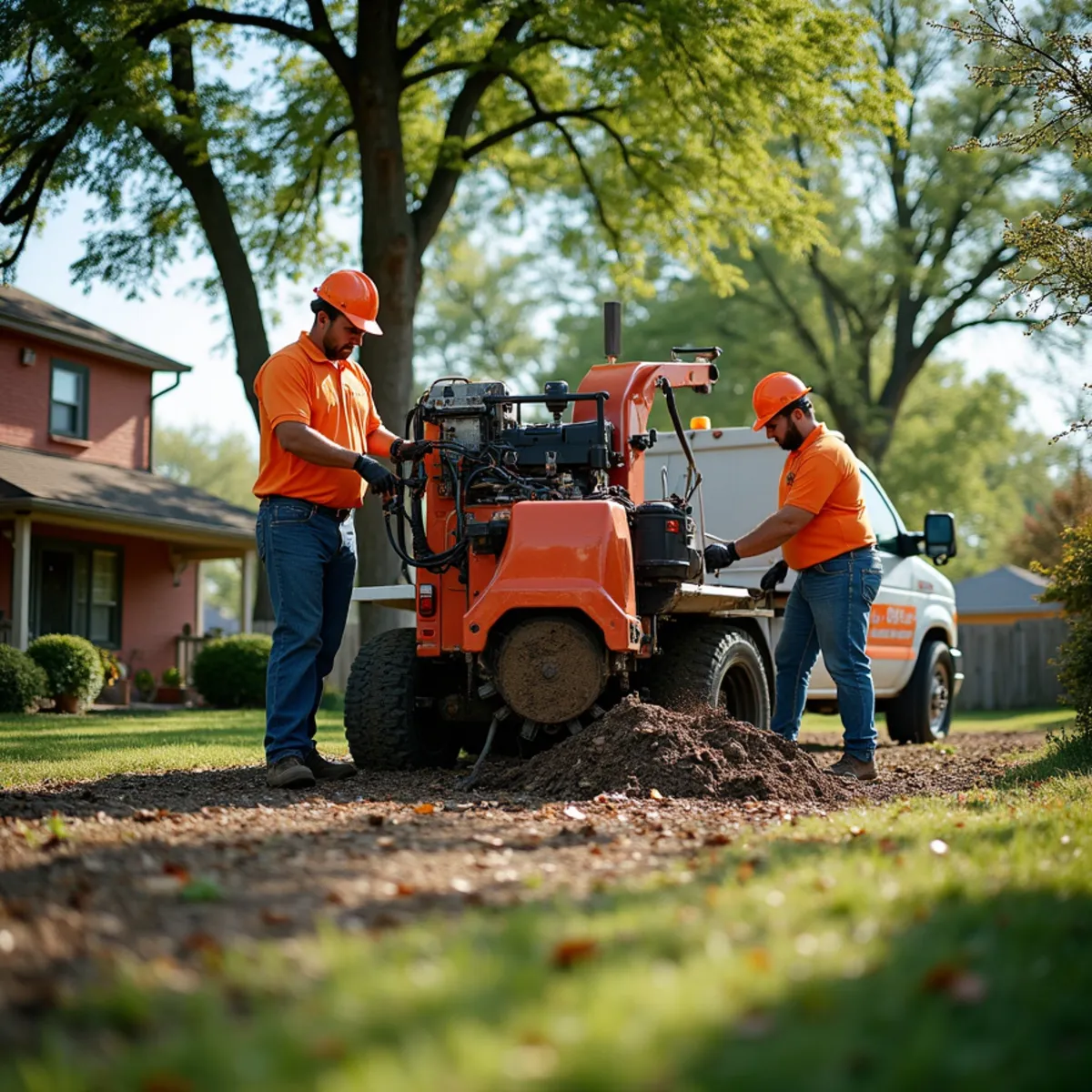
The cheapest way to turn a $250 stump job into a flooded backyard is to dig out a stump that sat right on top of a sprinkler main. In DFW, buried irrigation lines, gas laterals, and low-voltage wiring crisscross yards at shallow depth, and the shrink-swell clay we sit on shifts those lines over the years so they are rarely exactly where the plans say.
That is why the choice between grinding a stump and excavating it is not just about cost. It is about how much soil you disturb, and how likely you are to nick something expensive. In Carrollton and across the Metroplex, we almost always steer homeowners toward grinding for exactly this reason.
Here is how the two methods compare, and how we keep buried lines out of the cutter's path.
The two ways to get rid of a stump
Grinding uses a rotating cutting wheel to chew the stump and major roots down into mulch, typically to a few inches or a foot below grade. It stays shallow and disturbs a relatively small, controlled area right around the stump.
Excavation means digging the entire stump and root ball out of the ground with a machine. It removes more of the root mass, but it tears up a wide area and reaches the depth where irrigation, gas, and electrical lines commonly run. Near buried utilities, that extra reach is the problem, not a benefit.
Why grinding is usually the safer bet near lines
The single biggest risk to buried lines is depth and spread of disturbance, and grinding minimizes both. Because a grinder works the stump from the top down in a defined footprint, an operator can control exactly how deep and wide the cut goes and stop short of a marked line.
Excavation, by contrast, rips out soil in every direction and often at the exact depth where sprinkler mains sit. In our shifting clay, where a line may have migrated a foot from where it was installed, that is a recipe for a severed pipe and a repair bill that dwarfs the stump job. There are cases where excavation is the right call, such as when a diseased root system needs to come out entirely or a new structure is going in over the spot, but near live irrigation and utilities it is almost always the wrong tool for the job.
Locate first, always
No matter which method you choose, the work starts with knowing what is underground. Our process on every stump near a structure or irrigated area looks like this.
- Call 811 for public utility locates before any grinding or digging, which is free and required
- Walk the yard with the homeowner to map private lines like sprinkler heads, low-voltage lighting, and pet fences that 811 does not mark
- Probe and mark the stump's footprint and set a safe cutting boundary
- Grind in controlled passes, watching for pipe, wire, or gravel bedding that signals a buried line
- Backfill the grindings or haul them off, and reset grade so the spot settles evenly
What grinding leaves behind, and what to plan for
Grinding does not remove every root, and that is fine for most purposes. The remaining roots decay in place over a few years. If you plan to plant a new tree in the exact spot, tell us, because that changes how deep we grind and how we handle the leftover root mass and mulch.
You will also have a pile of grindings. They make good mulch, or we can haul them off and bring in soil so you can sod or plant right away. Decide that up front so the quote reflects it.
One more thing worth knowing about our clay: a freshly ground stump hole settles as the grindings and remaining roots break down and the soil compacts. If you sod right over a loose fill, you can end up with a shallow depression a season later. We overfill slightly and tamp the backfill so the spot settles closer to flush, and if you want it dead level for turf we bring in topsoil rather than relying on grindings alone. It is a small detail, but it is the difference between a clean lawn and a sunken patch that collects water every time it rains, which in our clay soil is its own slow problem for anything planted nearby.
Get a locate-and-grind quote
If your stump sits near sprinkler lines, a gas meter, or landscape lighting, do not let anyone dig it out blind. Our stump grinding crews grind clean, work around your buried lines, and reset the grade so you are not left with a crater.
We handle stumps throughout Carrollton and the surrounding suburbs, and we will always tell you honestly when grinding is the smarter, lower-risk choice. If the stump is one part of a larger yard cleanup, our residential tree care crews can fold it into the rest of the work so the whole job is coordinated. And if you have several stumps, tell us up front, because we can often set a price for the group that beats grinding them one at a time on separate visits. Call (855) 615-0568 for a free estimate that includes locating and protecting your underground lines.
How we grind a stump without splicing your sprinkler system
The danger with any stump near a DFW yard is what runs beside and under it: sprinkler lateral lines sit only 6 to 12 inches deep, drip tubing shallower, and low-voltage lighting and invisible-fence wire shallower still. Grinding blind is how a crew turns a one-hour job into a flooded lawn and a repair bill. Before the grinder starts we have the homeowner run each irrigation zone so we can spot head locations, and we call 811 for the public gas, water, and electric utilities, which is free and legally required but does not mark private sprinkler lines.
Grinding is the lower-risk choice because it chews the stump from the top down in a controlled zone, typically 6 to 12 inches below grade, without the wide soil disturbance of digging the whole root ball out. Full excavation rips up a much larger area and is far likelier to sever lines, though it is sometimes necessary where new construction needs the roots gone. When a stump sits right on top of a manifold or line, we hand-expose and flag the pipe first, or relocate the grind. The honest tradeoff: grinding leaves the deep roots to decay in place, which is fine for lawn but not where a foundation or new slab is going in.
- Call 811 first, but know it does not mark private irrigation, lighting, or pet-fence wire
- Run each sprinkler zone to locate heads and lines before the grinder starts
- Choose grinding over excavation near utilities to limit soil disturbance
- Hand-expose and flag any pipe directly under the stump before cutting