
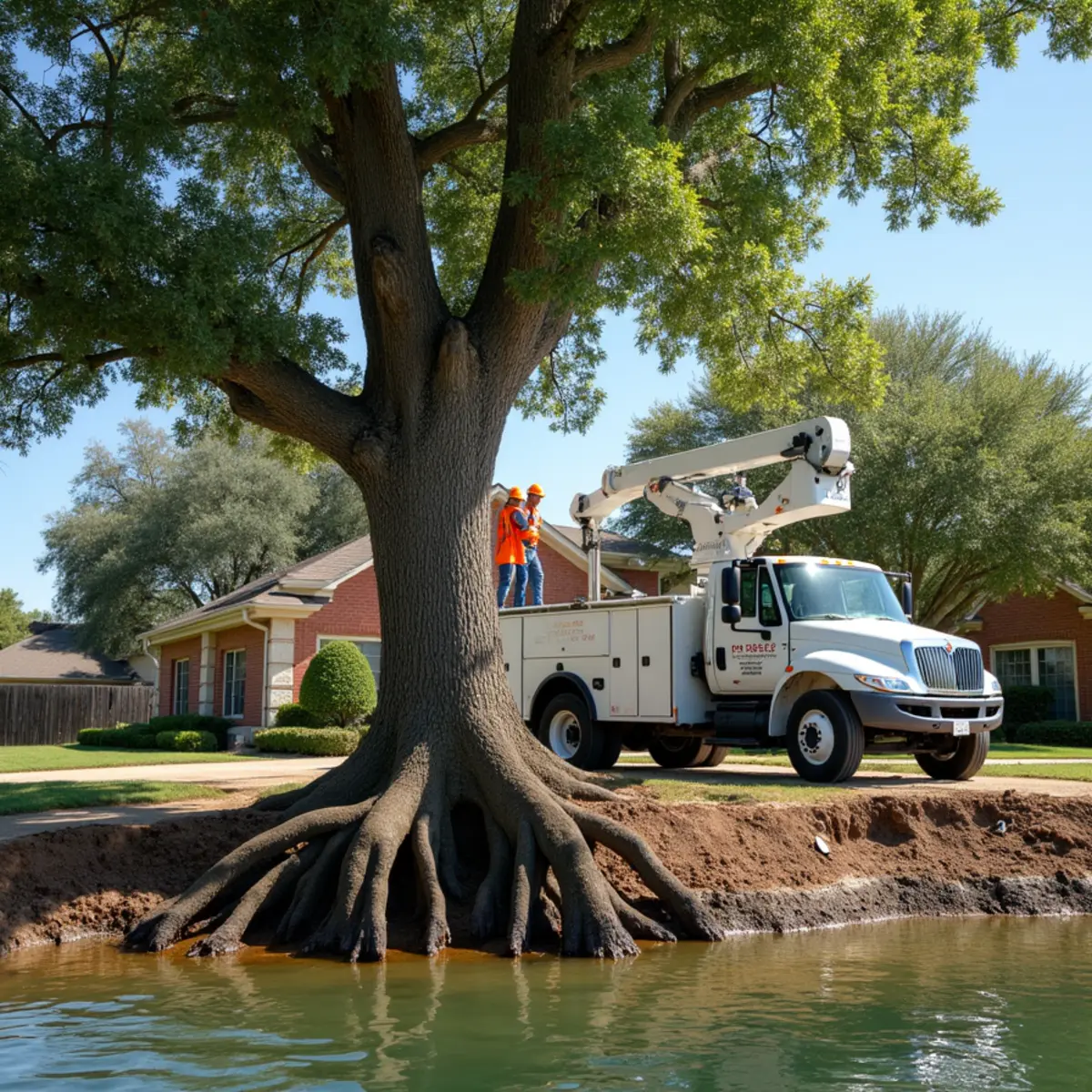
A lakefront lot is a beautiful place to own a tree and a hard place to keep one standing. Along Lewisville Lake and the shorelines around The Colony, the same water and wind that make the view also work around the clock to undermine the trees that frame it. Two forces do most of the damage: waves chewing at the bank below the roots, and wind coming off open water with nothing to slow it down.
Homeowners often notice a favorite shoreline tree leaning a little more each year, or find fresh soil at the base after a windy weekend, and assume it is fine because it has always been there. Shoreline trees fail differently than yard trees, and by the time the lean is obvious the anchorage may already be gone.
Here is what is actually happening below and around a lakefront tree, and how to stay ahead of it.
Wave erosion undercuts the roots you cannot see
The most dangerous shoreline hazard is invisible from the top of the bank. Every wave that laps the shore carries a little soil away, and over years that erosion eats back under the bank, leaving roots dangling in air or clinging to a shrinking wedge of ground.
A tree can look perfectly healthy up top while half its anchoring roots hang exposed over the water. When lake levels rise and fall, and after boat wakes and wind chop pound the bank, that undercut deepens. Eventually the remaining soil cannot hold the tree, and it slides or topples toward the water, often taking a chunk of your bank with it.
Wind shear on open water is relentless
Inland, trees shelter each other and buildings break the wind. On an open shoreline, a tree stands alone against wind that has crossed miles of open lake at full speed. That constant one-directional loading does two things: it stresses the trunk and root plate day after day, and it shapes the tree to lean and grow away from the prevailing wind.
A tree that has been shear-loaded for years often has a heavy side and a compromised windward root system, exactly the combination that fails in a storm. The lean you see is a symptom of that history, not a stable resting position.
Shoreline soils make it worse. The ground near a lake edge is often looser, sandier, or seasonally saturated, none of which grips roots the way firm upland clay does. So a shoreline tree is fighting stronger, steadier wind with weaker anchorage than the same species would have two lots inland. When we assess a lakefront tree, we are always weighing those two things together: how much load the canopy is catching, and how much the bank underneath it can still hold. A healthy-looking tree with a great view can be the one most likely to end up in the water.
What to watch on a shoreline tree
Walk your bank a few times a year, especially after high water or a windy stretch, and look for these signs.
- Exposed roots hanging over the water where the bank has eroded back
- A widening gap or overhang between the bank edge and the waterline
- A lean toward the water that increases year over year
- Cracked or heaved soil on the landward side of the trunk
- Fresh soil or a raised root plate after storms
- Dead limbs on the windward side from constant stress
Managing the risk without clear-cutting your view
The goal on a shoreline is to keep the trees you can keep safely and remove the ones that have lost their footing, while protecting the bank itself. Crown reduction lowers a tree's wind load and center of gravity, which buys stability for a tree whose roots are still sound. Removing deadwood cuts the debris that a lake wind will otherwise throw.
For trees whose roots are already undercut, reduction is not enough, and removal is the safe call before the tree fails into the water or onto a dock. Our residential tree care team assesses each shoreline tree individually so you keep the view where it is safe and lose only what has to go. When a tree is past saving, our tree removal crews work carefully on the bank to avoid worsening the erosion, and shoreline owners around The Colony rely on us to make that judgment honestly.
Get your shoreline trees assessed
Shoreline trees are a special case, and guessing at them is how a lake lot ends up with a tree in the water and a collapsed bank. A proper assessment looks at the roots, the erosion, the lean, and the wind exposure together, then gives you a plan that protects both your trees and your bank.
If your lakefront trees are leaning, showing exposed roots, or standing in an eroding bank, call (855) 615-0568 for a free shoreline tree assessment before storm season hits the open water. The best time to make that call is a calm week, not the morning after a big blow, when every lake lot on the shoreline is calling at once.
How a healthy-looking lakeside tree loses its footing
Shoreline trees at Lewisville Lake face a problem yard trees never do: the ground they stand in moves. Wave action and fluctuating pool levels erode soil away from the upslope side of the root plate, and saturated bank soil gives roots nothing firm to grip. A tree can look full and green in the canopy while half its anchoring roots hang exposed or sit in mush. The tell is the root flare, where the trunk widens into the ground; when one side of that flare is undercut or you see soil cracking behind the tree, it is already leaning toward failure.
We judge a lakeside tree by the root plate and the lean, not the leaves. A trunk that leans with a mound of heaved soil on the opposite side is actively pulling out and usually comes down. Shallow, saturated clay also drowns roots and invites root rot, so we probe for soft wood at the base and look for fungal brackets. Where a tree is worth keeping, bank stabilization and selective weight reduction on the lake-facing side can buy years. Where the root plate is gone, removal before it falls on a dock or house is the only honest call.
- Inspect the root flare for undercutting and exposed roots on the eroding side
- Treat a fresh lean with heaved soil behind it as active, progressing failure
- Probe the base for soft wood and fungal brackets signaling saturation rot
- Reduce weight on the lake-facing side where the tree is still sound enough to keep