
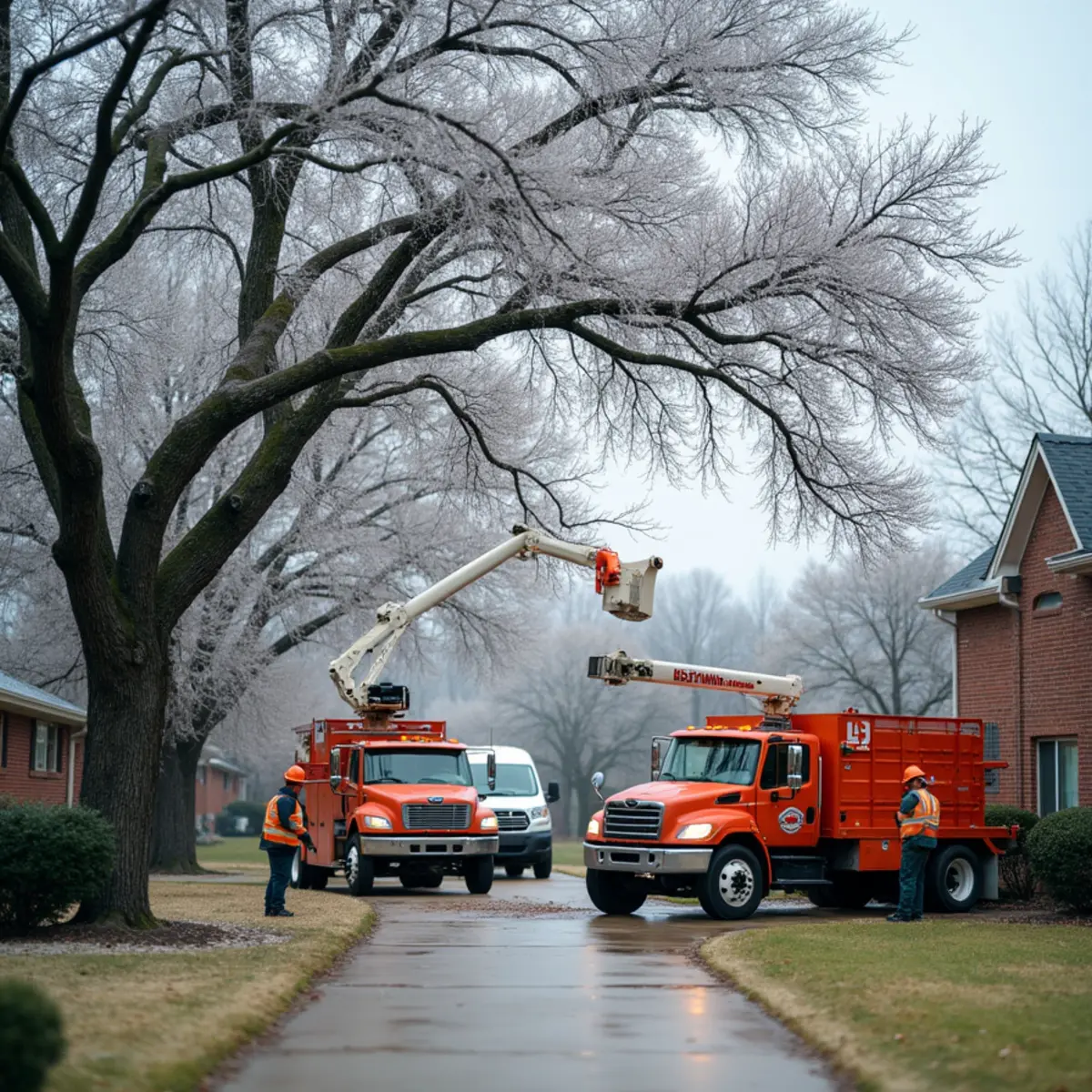
North Texas does not get many ice storms, but the ones it gets are brutal on trees, and the cleanup fills our schedule for weeks. Glaze ice, the clear, hard coating that forms when freezing rain hits cold branches, is far heavier than it looks. A quarter inch of it can add hundreds of pounds to a single limb, and our trees are simply not built for that kind of load.
Two species take the worst of it here: pines, which hold enormous surface area on their needles, and cedar elms, whose fine twiggy branch structure catches ice everywhere at once. When those limbs let go, they come down hard on roofs, cars, and power lines, often in the middle of a night when no crew can safely reach them.
Here is why these trees fail under ice, and what you can do before and after the storm.
Why glaze ice is so destructive
Glaze ice forms when rain falls through a cold layer and freezes on contact with branches that are below freezing. Unlike snow, which can blow off, glaze locks onto every surface and builds up in a solid shell. The weight adds up fast, and it loads the whole tree at once rather than at a single point.
The failure mode is overload. A limb that easily carries its own leaves and its own weight suddenly has several times that hanging on it, applied as a steady downward pull. Wood that is strong in normal conditions bends, then cracks, then breaks, and often it is the biggest, most valuable limbs that go because they carry the most ice.
Why pines and cedar elms fail first
Pines are evergreen, so in an ice event every needle is a surface for ice to grip, giving a pine an enormous ice-catching area compared to a bare hardwood. That load, high in a tall narrow crown, is why pines shed big limbs and sometimes snap outright.
Cedar elms fail for the opposite reason. Their branch structure is fine and densely twiggy, so ice coats a huge number of small branches, and the combined weight overwhelms the many slender limbs that make up the canopy. Cedar elms also tend to hold onto weak, narrow-angled unions, which are the first to split when the load climbs.
The timing of North Texas ice is part of the problem, too. Our freezes often arrive after a mild stretch when trees are not fully hardened off and still carry leaves, especially on evergreens and slow-dropping species, which gives the ice even more surface to grab. And because ice storms here are rare, our trees have not been shaped by generations of them the way northern trees have, so they carry structure that a colder climate would have pruned out long ago. That combination, unhardened trees and unpracticed structure meeting a heavy glaze, is why one bad ice event can do more damage in a single night than a whole summer of thunderstorms.
What to do before winter
You cannot ice-proof a tree, but you can reduce the load it has to carry and remove the parts most likely to fail. The best time to do it is before the first freeze, on your schedule, not during the storm.
- Remove deadwood, which is brittle and the first to break under ice
- Reduce overextended limbs that reach over roofs, cars, and power lines
- Thin dense cedar elm canopies modestly to cut the ice-catching surface
- Address weak, narrow branch unions with reduction or cabling where warranted
- Clear branches back off the roof and the service drop before winter
After the storm: leave the hangers alone
When the ice finally breaks limbs, the most dangerous things in your yard are the ones that did not fall all the way. A limb that cracked and is hanging in the canopy, snagged on lower branches or dangling by a strip of bark, is a widow-maker. It can release the moment someone walks under it or the ice starts to melt and shift.
Do not try to pull hangers down yourself, and never work near a limb that is on or near a power line. This is exactly the work our hanging limb removal crews are equipped for, with the ropes and reach to take a broken limb down under control. For the wider mess of downed wood and debris, our storm damage cleanup teams clear it and haul it off so you can get your driveway and yard back.
Prep before the freeze, call us after
The homeowners who come through an ice storm best are the ones who reduced their risk in the fall and had a number to call when limbs came down. We do both: preventive pruning before winter, and fast cleanup after.
We serve Lewisville and the surrounding communities through every winter storm. Keep our number where you can find it in the dark with the power out, because that is exactly when a hanging limb over the driveway becomes an emergency. Call (855) 615-0568 for a free estimate on winter prep now, or for storm cleanup after the ice hits.
Which trees we brace before the ice and which we leave alone
Not all trees fail the same way under ice load, so we prep them differently. Loblolly and other pines hold their needles through winter, so they collect a huge surface of ice and often snap at the top or bend and never recover. Cedar elms keep fine twiggy growth that glazes heavily and loses the brittle smaller limbs first. Live oaks, with denser wood, tend to lose individual branches rather than whole crowns. Knowing the species tells us whether to reduce weight, cable a weak union, or simply clear targets beneath it.
The honest limit is that ice storms overwhelm even good trees, and our job before one is risk reduction, not a guarantee. We focus on removing existing deadwood, which fails first under any added load, and on reducing long, over-extended limbs that gather the most ice leverage. What we do not do is top a tree in a panic, because that creates weak regrowth that is even more fragile in the next storm. After the storm, the priority flips to safe cleanup: hanging limbs and split unions under tension are the most dangerous part of the whole event.
- Prioritize deadwood removal; dead limbs fail first under ice load
- Reduce long over-extended limbs that gather the most ice leverage
- Match prep to species: pines snap up top, cedar elms lose brittle twiggy limbs
- After the storm, treat hanging limbs and tensioned split unions as the top hazard